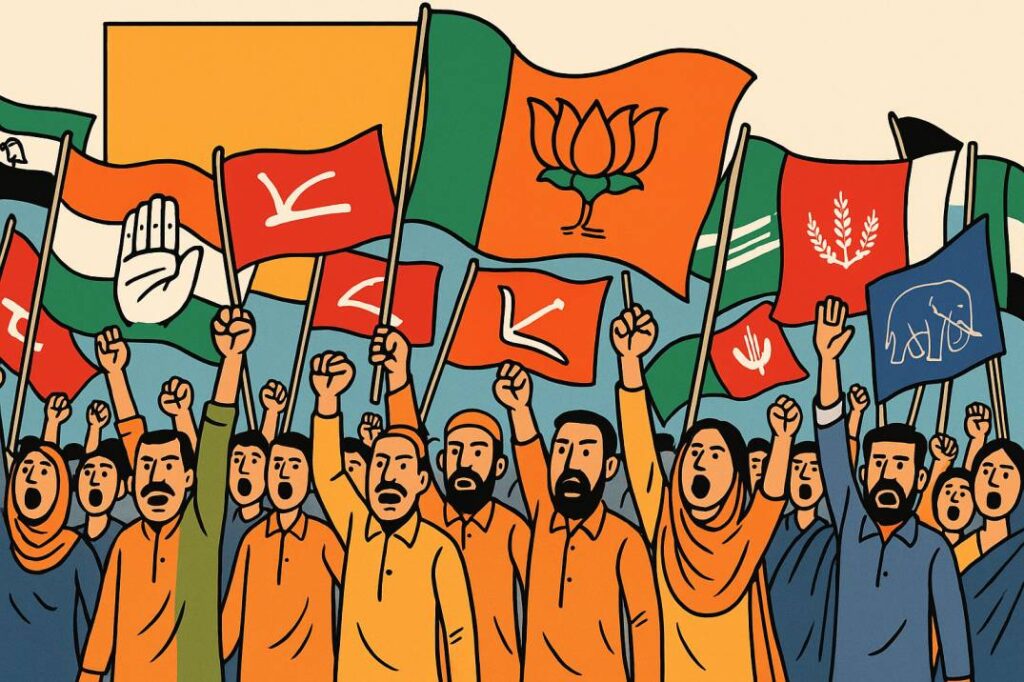
Why Indian Politics Lags Behind & How India Can Compete
Introduction: India’s Political Reality in December 2025
India enters 2025 with elements of continuity and change under Prime Minister Narendra Modi’s coalition government. As the world’s largest democracy with 1.4 billion citizens and the fastest-growing major economy, India presents a striking paradox. The IMF projects India’s GDP growth at 6.6% for 2025-26, positioning it as the fastest-growing major economy ahead of China’s 4.8%.
Yet Parliament’s recent debate on electoral reforms became a spectacle of political conflict rather than a substantive discussion on policy. This comprehensive analysis examines why Indian politics faces critical challenges and explores pathways for India to compete globally.
The Core Problems in Indian Politics: 2025 Update
1. Corruption Crisis Deepens
India ranks 96th out of 180 countries in the 2024 Corruption Perceptions Index with a score of 38, a decline from 93rd position in 2023. This worsening trend reflects deteriorating public sector integrity.
Current Ground Reality:
89% of people think government corruption is a big problem, and 39% of public service users paid a bribe in the previous 12 months. The scale of corruption continues to hamper India’s development potential and investor confidence.
Comparative Context:
India’s CPI score dropped from 39 in 2024 to 38 in 2025, indicating ongoing struggles with corruption at various governance levels, especially within bureaucratic systems and political patronage networks.
2. Electoral System Under Fire
Over the past months, concerns over voter roll deletions, the opacity of political funding, questions about the independence of the Election Commission and the ongoing nationwide Special Intensive Revision had set the stage for a serious legislative conversation.
Key Democratic Challenges:
- The debate did not examine the structural bottlenecks that persistently affect voter registration and deletion.
- After the Supreme Court struck down the electoral bonds scheme earlier this year, there has been a strident call for a new, transparent model for funding political parties.
- The preelection arrest of Delhi’s chief minister and the freezing of the main opposition party’s bank accounts in March amplified concerns about the misuse of investigative agencies to target the political opposition.
3. Youth Unemployment at Crisis Levels
The unemployment rate for youth aged 15-29 increased to 16.1% in Q3 FY25 from 15.8% in Q2 FY25. This represents a severe challenge for India’s demographic dividend.
Alarming Statistics:
- Urban youth joblessness surged to 19.0%.
- Youth unemployment in Himachal Pradesh reached 29.6%, Punjab 20.2%, and Haryana 15.6%, all above the national average.
- Youth make up nearly 83% of India’s unemployed population, with urban youth unemployment at 18.8% and rural youth at 13.8%.
The Education-Employment Gap:
The share of young people with at least a secondary education among the unemployed has nearly doubled from 35.2% in 2000 to 65.7% in 2022. This massive skills mismatch threatens India’s future prosperity.
Reality Check:
About 28 million unemployed educated youth are looking for decent jobs, and about 100 million educated youth, mostly women, are not actively looking for employment. The youth are increasingly falling out of the labour force as they are not finding work: they are becoming ‘discouraged workers.’
4. Democratic Institutions Weakening
While India is a multiparty democracy, the government led by Prime Minister Narendra Modi and the Hindu nationalist Bharatiya Janata Party has presided over discriminatory policies and a rise in persecution affecting Muslims.
2024-25 Developments:
- The inauguration of the Ram temple in Ayodhya in January symbolized the culmination of a protracted dispute over the site’s status.
- In March, the government implemented the Citizenship Amendment Act, which critics claim unfairly excludes Muslim refugees and erodes India’s secular values.
- Ladakh witnessed some of its most intense protests since it became a Union territory in 2019, with clashes with security forces leaving four people dead and around 90 injured on September 24 and 25.
5. State Election Results: Mixed Signals
The Bharatiya Janata Party returned to power in Delhi after nearly three decades, winning 48 seats, while the Aam Aadmi Party finished with 22 seats. However, Modi’s coalition secured a landslide victory in Bihar, with the NDA poised to cross the 200-mark in the 243-member legislature.
Why Indian Politics Differs from Developed Democracies
Structural Legacy Issues
Colonial Hangover: India’s corruption traces back to the British Raj period, which created secretive bureaucratic systems. The 1923 Official Secrets Act institutionalized opacity that persists today.
Scale Complexity: Managing a democracy of 1.4 billion people across 28 states with diverse languages, religions, and economic conditions is exponentially more complex than governing smaller, homogeneous developed nations.
Institutional Weaknesses
In recent years, the Election Commission’s impartiality has been called into question. A 2009 survey revealed Indian bureaucracy is the least efficient among Singapore, Hong Kong, Thailand, South Korea, Japan, Malaysia, Taiwan, Vietnam, China, Philippines and Indonesia.
Developed Countries’ Advantages:
- Strong, independent institutions
- Transparent bureaucracies
- Effective accountability systems
- Merit-based civil services
- Robust rule of law frameworks
India’s Global Competitiveness: 2025-26 Standing
Economic Performance
GDP Growth Leadership:
The Indian gross domestic product expanded by 8.2% from the previous year in the September quarter of 2025, well above the market consensus of a 7.3% expansion. This was the sharpest annual growth rate since March 2024.
For the full fiscal year of 2025, the Indian GDP expanded by 6.5%, the least in four years. However, India’s strong services activity helped GDP growth beat expectations for the second quarter in a row, rising to 7.8% for April-June 2025.
Growth Projections:
- IMF projects 6.6% growth for 2025-26, outpacing China
- Asian Development Bank forecasts 6.7% growth in FY2025, with 6.8% projected for FY2026
- Deloitte forecasts GDP growth between 6.5% and 6.7% in FY2026
Long-term Trajectory:
Currently the world’s fourth-largest economy, India is on track to become the third-largest by 2030 with a projected $7.3 trillion GDP.
Innovation Progress
India achieved 39th position in the Global Innovation Index 2024, rising dramatically from 81st position in 2015. As of September 2024, over 1,49,414 entities have been officially recognized as startups.
Competitiveness Gaps
Despite economic momentum, significant challenges remain:
- India ranks 40th on the IMD World Competitiveness Index
- Ranked 115th in the Global Peace Index 2025
- 130th in the Human Development Index 2025
- 96th out of 180 countries in the 2024 Corruption Perceptions Index
How India Can Compete with Top Countries: 2025-26 Roadmap
1. Fix Democratic Institutions Urgently
Electoral reforms form the backbone of democratic legitimacy, yet the political establishment continues to treat them as an arena for point-scoring rather than policymaking.
Immediate Actions:
- Establish independent anti-corruption bodies with prosecutorial powers
- Create transparent audit mechanisms for voter registration and deletion processes
- Articulate the contours of a cleaner funding system after the electoral bonds scheme was struck down
- Protect judicial independence through transparent appointments
2. Address the Jobs Crisis
Each year, over 12 million young people pour into the Indian labour force, a demographic wave with the potential to be a dividend. However, India’s workforce is rapidly ageing, with almost half comprising people over 45 years old.
Critical Solutions:
Manufacturing Revival: Automation and Artificial Intelligence are changing industries that once served as engines for creating good jobs. India must adapt by:
- Streamlining land acquisition and labor reforms
- Building robust supply chain infrastructure
- Reducing bureaucratic red tape
- Creating export-ready manufacturing capabilities
Skills Development: A recent NASSCOM report highlighted the significant gap between the skills industry demands—such as critical thinking, data analytics, and green-tech expertise—and the skills possessed by the graduate pool.
- Align education with industry needs
- Expand vocational training programs
- Focus on AI, data science, and green technologies
- Increase female workforce participation
3. Economic Transformation
Sustain High Growth:
Analysts predict that India could overtake Japan in 2025 to become the second-largest economy in Asia and fourth largest in the world. Over the past decade, India’s economic size has expanded sharply from ₹106.57 lakh crore in 2014-15 to an expected ₹331.03 lakh crore in 2024-25, nearly tripling in ten years.
Key Enablers:
- Direct income tax exemptions, continued GST reforms, and accommodative monetary policy
- Strong domestic consumer demand
- Infrastructure investment momentum
- Easing inflation to 2.82% in May 2025
4. Infrastructure Development
India follows a four-slab GST structure of 5%, 12%, 18% and 28%, which has simplified compliance, reduced costs, and enabled seamless movement of goods across states.
Priority Areas:
- Expand transportation networks
- Build smart cities with sustainable planning
- Develop world-class ports and logistics
- Ensure universal electricity and water access
5. Governance and Anti-Corruption
Leverage Technology:
- Expand digital governance to reduce human interface
- Implement blockchain for transparent procurement
- Use AI for detecting corruption patterns
- Create citizen-centric service delivery
Strengthen Legal Framework:
- Fast-track corruption cases in special courts
- Implement asset declaration for all officials
- Protect whistleblowers effectively
- Ensure prosecution regardless of political affiliation
6. Foreign Policy Balance
The two countries recently signed their biggest energy agreement worth US$13 billion, sending half a million barrels per day of Russian crude to Indian refiners over the next decade.
Strategic Challenges:
U.S. prosecutors charged Gautam Adani and several partners in November 2024 with allegedly paying US$250 million to bribe government officials, sending political shockwaves through the country.
Balanced Approach:
- Maintain strategic autonomy while building partnerships
- Navigate US-Russia-China dynamics carefully
- Lead Global South initiatives
- Attract foreign direct investment
7. Social Inclusion
Address Regional Disparities:
Peninsular states have per capita incomes 50% higher than north Indian states like Uttar Pradesh and Bihar. This gap must be bridged through:
- Equitable distribution of development benefits
- Protection of minority rights
- Empowerment of marginalized communities
- Urban-rural service delivery parity
8. Environmental Sustainability
India ranks 10th in the Climate Change Performance Index 2025, showcasing progress in renewable energy.
Green Growth Path:
- Accelerate renewable energy adoption
- Invest in electric mobility
- Implement circular economy principles
- Balance development with environmental protection
Learning from Success Stories
Nordic Model Adaptations
Denmark, Sweden, and Finland consistently rank highest in competitiveness and quality of life:
- Transparent governance with open data initiatives
- Investment in free, high-quality education and healthcare
- Government-industry-academia collaboration
- Social safety nets without stifling entrepreneurship
Asian Tigers’ Lessons
Singapore, South Korea, and Taiwan transformed within decades:
- Meritocratic, corruption-free civil services
- Export-led growth building competitive sectors
- World-class universities and research centers
- Long-term vision with consistent policies
The Path Forward: 2025-2030 Priorities
Immediate Actions (2025-2026)
- Electoral Reform: Fix flawed voter rolls, establish institutional checks on the Election Commission, ensure full transparency in political funding, and create a predictable legal framework
- Jobs Emergency: Create 12+ million jobs annually through labor-intensive sectors
- Corruption Crackdown: High-profile prosecutions across political spectrum
- Social Harmony: Prevent and punish communal violence
Medium-term Goals (2027-2030)
- Education Revolution: Transform learning outcomes
- Manufacturing Hub: Become alternative to China
- Digital Leadership: Leverage technology for growth
- Infrastructure Excellence: Achieve developed-nation standards
Long-term Vision (2030 onwards)
- Developed Nation Status: India is projected to reach $7.3 trillion GDP by 2030
- Innovation Leader: Rank among top 10 globally
- Democratic Model: Prove inclusive democracy delivers
- Global Influence: Leadership in multilateral institutions
Conclusion: India’s Moment of Truth
Unless flawed voter rolls are corrected, there are institutional checks on the Election Commission, full transparency in political funding, and a predictable legal framework for delimitation, the electoral credibility of India will remain a contentious issue.
India’s political challenges are neither insurmountable nor uncommon for a developing democracy of its scale. A victory in Bihar strengthens the party in power as the state is seen as a political bellwether, setting political trends across India’s Hindi-speaking heartland. The recent state elections signal both continuity and potential for change.
The sharp pick-up in growth in April-June 2025 to 7.8% reflects the resilience of the Indian economy. However, achieving the 8% sustained growth needed for developed nation status by 2047 requires addressing political dysfunction alongside economic reforms.
India possesses unique advantages: vibrant democracy, demographic dividend, technological talent, and entrepreneurial spirit. India presents a stark economic paradox—as it cements its position as the world’s fastest-growing major economy with GDP growth rates consistently north of 7 percent, the national discourse seems centered around the chronic unemployment crisis.
Success requires honest acknowledgment of political failures, institutional reforms, inclusive development, and sustained commitment to democratic values. With 1.4 billion people’s futures at stake, the time for transformative action is now.